
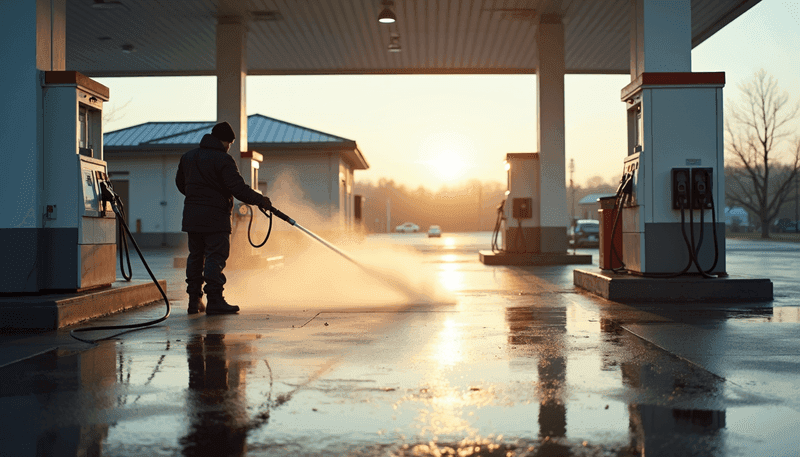
Keeping a gas station clean and inviting is essential for attracting customers and maintaining safety. Over time, dirt, oil stains, grime, and the effects of heavy traffic and weather accumulate on the pavement, fuel pump canopies, and building exteriors. A visibly dirty forecourt sends the wrong message to potential customers — and can create genuine safety hazards.
Why Gas Stations Require Specialized Cleaning
Gas station environments are uniquely challenging. You're dealing with:
Standard pressure washing with cold water moves surface grime but cannot effectively break down petroleum-based staining. Hot water power washing — combined with commercial-grade degreasers — is the only method that truly removes oil contamination from concrete.
Key Areas to Address
A complete gas station power washing service should cover:
The Power Washing Process for Petroleum Stains
Effective petroleum stain removal from concrete is a multi-step process:
1. Pre-treatment: Commercial degreaser is applied to the stained area and allowed to dwell, breaking down the oil at a molecular level
2. Hot water power washing: Heated water (180–200°F) at high pressure lifts the emulsified petroleum from the concrete pores
3. Rinse and wastewater management: Proper containment and disposal of wash water is required — petroleum-contaminated runoff cannot simply flow into storm drains
4. Repeat treatment: Severe or long-set stains may require multiple passes
5. Optional concrete sealing: Sealing the forecourt after cleaning dramatically reduces future oil penetration
Wastewater Compliance
This is where many commercial cleaning operations fall short. Wash water from a gas station forecourt contains petroleum products, cleaning agents, and other contaminants regulated under the Clean Water Act. It cannot be allowed to run into storm drains or nearby waterways.
Viking Power Washing uses containment berms and vacuum recovery equipment where required to collect and properly dispose of wash water in compliance with local regulations. If you're evaluating cleaning companies, ask directly about their wastewater management practices — the risk of a regulatory violation falls on the property owner.
How Often Should a Gas Station Be Power Washed?
Most high-volume gas stations benefit from power washing every 3–6 months. Factors that affect frequency include:
A regular maintenance contract is typically more cost-effective than periodic one-off cleans — and keeps your facility looking its best year-round.
The ROI of a Clean Forecourt
Studies consistently show that customers make split-second judgments about fuel station quality based on appearance. A clean, well-maintained forecourt signals that the business is well-managed — which translates directly to fuel and convenience store sales. Conversely, oil-stained concrete, dirty pump islands, and grimy canopies drive customers to competitors even when prices are similar.
For multi-site fuel operators in the Cincinnati and NKY market, Viking Power Washing offers commercial service agreements that keep every location on a consistent cleaning schedule.
Get a Commercial Cleaning Quote
Viking Power Washing has extensive experience with commercial and industrial power washing throughout Cincinnati and Northern Kentucky. We're fully licensed, insured, and equipped for large-scale commercial work.
Call 513-995-1800 or contact us online for a free commercial cleaning estimate. We'll assess your property and put together a maintenance plan that fits your schedule and budget.